The Golden Day Has Finally Arrived — Our First Honey Harvest of 2026 🍯
🐝 Hadley Wood Honey — Spring 2026
"Somewhere between the sweat dripping down our backs and the sticky golden rivers flowing freely into the extractor, we knew — this was going to be a good start."
☀️ Hot, Sticky, and Absolutely Wonderful
We couldn't have ordered worse weather if we'd tried. The hottest day of the year so far chose to coincide — with impeccable timing — with our first big honey harvest of 2026. Thick, heavy heat settled over everything like a warm blanket nobody asked for. And there we all were, suited up, elbow-deep in beeswax, grinning like idiots.
This is the thing about harvest day. You spend months thinking about it, tending the hives, watching the bees come and go, wondering whether this will be the season. And then suddenly it's here, the sun is blazing, your friends have turned up with sleeves rolled up and a completely misplaced sense of how tiring this is going to be — and you just get on with it.
This year's spring wildflower honey is pure, raw, and coarse-filtered — exactly the way nature intended. Every drop came from the bees working the wildflowers, hedgerows, and blooming gardens around Hadley Wood, and we didn't do a single thing to mess that up.
⚙️ From Hive to Bucket — A Day in the Life of a Honey Harvest
For those who've never seen a honey harvest up close, here's exactly how our day unfolded — from first bucket of soapy water to last celebratory cup of tea.
1. Clean Down the Equipment — Before a single frame is touched, everything gets scrubbed. Extractors, uncapping trays, filters, buckets — all spotless and food-safe. You don't start a harvest until the barn smells more like a clean kitchen than a shed.
2. Prepare the Tools — Hot uncapping knives ready? Check. Honey extractor assembled and spinning freely? Check. Filters in place, settling tanks at the ready? Check. In the sweltering heat of the barn, with everyone getting in each other's way and having a wonderful time — check.
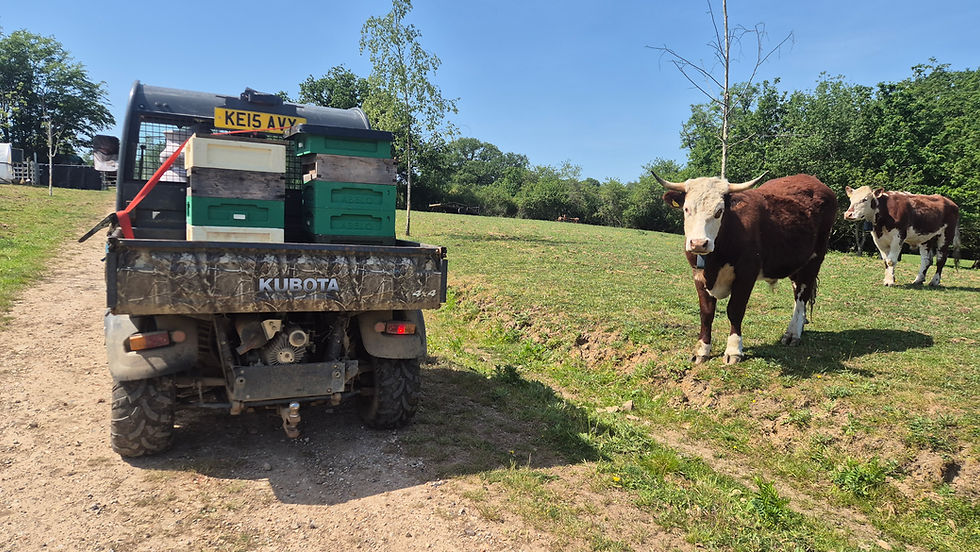
3. Remove the Honey Supers from the Hives — Out to the hives we go, dressed for the occasion. The honey supers — the upper boxes stacked on the hives where the bees store their excess honey — are carefully lifted free. Heavy, wonderfully heavy.
4. Remove the Bees from the Supers — The bees, understandably, are not immediately thrilled about this arrangement. With a little gentle persuasion (and a lot of patience), the frames are cleared of their occupants before being transported. No bees were stressed in the making of this honey.
5. Transport the Supers to the Barn — Arm by burning arm, the loaded supers make the trip from hive to barn. At this point someone always says "they're heavier than last year" — and this year, they were absolutely right.
6. Uncapping the Frames — Each frame of capped honey is sliced open with a hot uncapping knife, revealing the glistening cells beneath. The smell alone — warm wax and fresh wildflower honey — is enough to make the whole sweaty endeavour utterly worthwhile.
7. Centrifugal Spinning — The uncapped frames go into the extractor, which spins them at speed, flinging honey outward by centrifugal force until it runs down the walls and pools at the bottom in a gorgeous amber lake. Pure physics, pure magic.
8. Filtering the Honey — A coarse filter removes the bits that hitched a ride — the odd wing, a leg or two, fragments of wax. Nothing harmful, nothing sinister, just the naturally-collected debris of a busy hive. After filtering, what remains is gloriously pure wildflower honey.
9. Storing Overnight to Rest — The honey is poured into large food-grade settling buckets and left to rest overnight. Air bubbles rise, any remaining particles float to the surface, and the honey settles into its final golden self. Patience is, as always, rewarded.
10. Clean Everything Again — Yes, again. Extractor, trays, knives, filters, every sticky surface. In 32°C heat. With tired arms. This is the part no Instagram post ever captures — but it matters, and the team did it brilliantly.

🔬 A Bit of Bee Science
Why coarse filter? Raw honey retains its natural pollen, enzymes, antioxidants, and beneficial compounds. Coarse filtering removes physical debris (wax, propolis fragments, the occasional bee bit) without stripping away any of the good stuff. Fine filtration or heating destroys much of what makes raw honey special.
How do bees make honey? Worker bees collect nectar from flowers — visiting up to 1,500 flowers to fill their honey stomach. Back at the hive, they pass it between themselves, adding enzymes, and fan it with their wings to evaporate water until the moisture content drops to around 17–20%. Then they seal it with beeswax. That's your jar of honey, right there.
What makes spring wildflower honey different? The flavour profile is shaped entirely by what's blooming in the surrounding landscape. Spring honey tends to be lighter, floral, and fresh — reflecting the season's early bloomers: clover, dandelion, hawthorn blossom, fruit trees, and the wildflowers of our local hedgerows.
Want to go deeper? Visit our Bee Education page at hwhoney.co.uk/bee-education for the full story on how our bees make this extraordinary stuff.

🏆 192kg — A New Record for Hadley Wood Honey
🎉 🐝 🍯 🌸 🙌
We'll be honest — nobody was expecting this. When the final buckets were weighed and the numbers added up, there was a brief silence followed by a very undignified amount of cheering. 192 kilograms of pure spring wildflower honey — an absolute record for us, and a testament to some very, very hardworking bees.
None of this would have happened without our incredible friends who gave up a scorching day, rolled up their sleeves, and gave every last drop of energy (sometimes quite literally running with sticky hands from one end of the barn to the other). All hands on deck. Happy vibes. Tired bodies. Best day.

❤️ It Takes a Group of Friends(and a Barn Full of Sticky Hands)
Beekeeping at Hadley Wood has always been a family affair, and harvest day is where that really shows. Our friends didn't just show up — they showed up cheerfully, worked tirelessly, and somehow found the energy to laugh all the way through. There were sticky hands, dripping elbows, someone got wax in their hair, and someone else definitely tasted more honey than was strictly necessary during "quality control".
To everyone who was there: thank you. Genuinely. You are the reason this is so much more than just beekeeping — it's a proper community, a brilliant tradition, and the best possible way to spend a hot spring day.
Now go get some sleep. You've earned it.


Comments